

Policy Evaluation
BCEC plays an active role in policy forecasting and evaluation. A range of applied economic methods are used to evaluate the content, implementation and impact of current and proposed policies across Australia. Evaluation findings can highlight ‘winners’ and ‘losers’ in the population under proposed and existing policy reforms, as well as the overall budgetary implications of proposed reforms at both Federal and State levels.
The findings from the Centre’s evaluations are intended to inform decision-making by policymakers in regard to the benefits and trade-offs of proposed policy changes. Examples of evaluations on current and proposed programs that the Centre’s researchers have conducted include the NSW government’s ‘Keep Them Safe’ child protection initiative, the national Headspace program providing early intervention mental health services to young people, and a range of housing-related policies and programs such as changes to the First Home Owner’s Grant, stamp duty and land tax provisions, and public housing rent-setting rules.
Related Projects
See All Mental Awareness, Respect and Safety (MARS) Landmark Study
 Family and Domestic Violence Leave Review
 Inquiry into pathways to housing tax reform
 An Investigation into the Drivers of Housing Supply Responsiveness in Australia
 Aboriginal Assets? The impact of major agreements associated with Native title in Western Australia
 headspace Evaluation
Related Publications
See All View the presentation by lead authors Dr Adam Crowe, Research Fellow, Curtin AHURI Research Centre, and Professo Alan Duncan, Director, Bankwest Curtin Economics Centre, from the launch of the report Building the Dream: The future of Western Australia’s construction industry, on... Read article
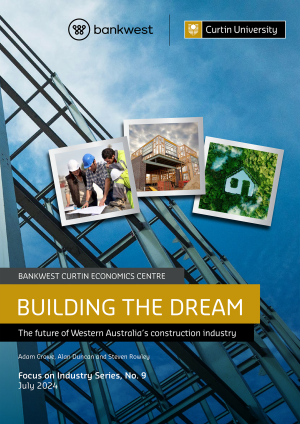 Watch the full report launch online here, and access the presentation slides here. Building the Dream, the ninth report in the BCEC Focus on Industry series, reveals that at current rates of dwelling completion, Western Australia will fall well short... Read article
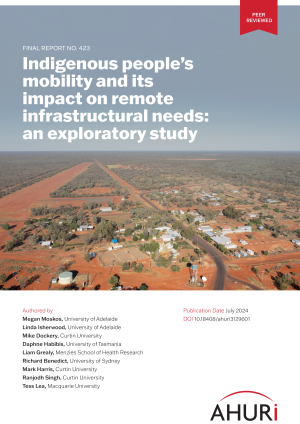 With Indigenous populations at risk of higher rates of infection and more serious disease than non-Indigenous populations, a policy of returning to remote communities (i.e. Return to Country) was encouraged during the COVID-19 pandemic. This policy led to high expectations... Read article
 2023 was another busy year for the Bankwest Curtin Economics Centre (BCEC). BCEC’s publications were widely read with almost 7,000 downloads. Media mentioning BCEC was widely consumed, reaching nearly 20 million people across television, print, radio and online. Thematically, housing... Read article
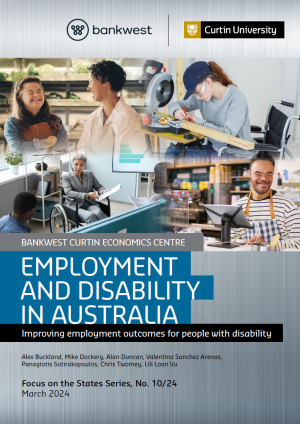
 View the presentation by lead authors Professor Mike Dockery, Principal Research Fellow, and Professor Alan Duncan, Director, both of Bankwest Curtin Economics Centre, from the launch of the report Employment and disability in Australia: Improving employment outcomes for people with disability, on... Read article
 The eighth report in the Gender Equity Insights series from the Bankwest Curtin Economics Centre (BCEC) and the Workplace Gender Equality Agency (WGEA) looks at the gender equality strategies at nearly 4,800 Australian employers to determine what factors are accelerating... Read article
 The Bankwest Curtin Economics Centre team acknowledges the Wadjuk Nyungar people as the traditional owners of the land on which the Centre is situated.