
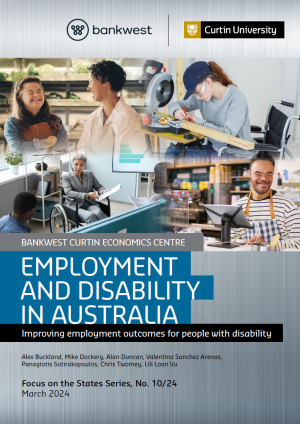
Productivity and Innovation
The National Innovation and Science Agenda has committed significant amounts of funding to twenty eight action areas, which include de-risking start-ups; investing in STEM; attracting and keeping overseas entrepreneurs; and improving university-industry connectedness, amongst others. These measures signal that promoting a culture of innovation is essential to Australia’s economic growth and future prosperity.
Projects under this theme explore the opportunity and challenges for businesses, individuals and government to drive prosperity through improved productivity and innovation. Research under this theme investigates issues such as barriers and enablers to productivity, and the impacts of infrastructure development and investment, public services, as well as tax and regulatory burdens on economic growth in WA, and opportunities and barriers to innovation for micro-businesses and SMEs, which make up a significant proportion of all businesses in the Australian economy.
Related Projects
See All Canning Vale Food Value Add Precinct
 Australia’s First Regional Digital Innovation District and City
 Relationships between metropolitan, satellite and regional city size, spatial context and economic productivity
 Making Connections: Housing, Productivity and Economic Development
 Economic Forecasting Model for Western Australia
 The Insertion of Australia and WA in International Gas and Oil Markets
Related Publications
See All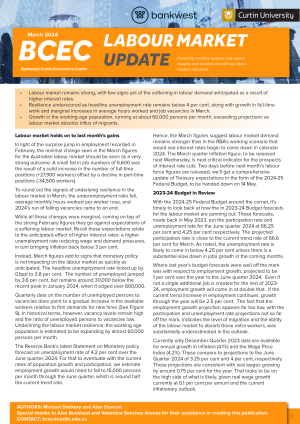 — Labour market remains strong, with few signs yet of the softening in labour demand anticipated as a result of higher interest rates. — — Resilience underscored as headline unemployment rate remains below 4 per cent, along with growth in... Read article
 — Employment jumps by 116,500 workers in February, or 0.8 per cent in a single month. — — Headline unemployment rate tumbles back to 3.7 per cent, down from 4.1 per cent in January. — — Robust labour market erodes... Read article
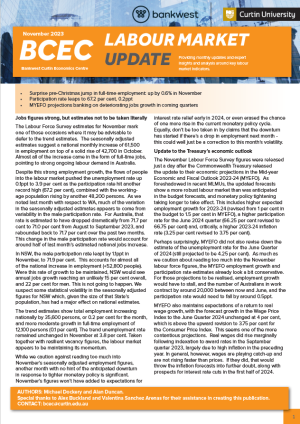 – Surprise pre-Christmas jump in full-time employment: up by 0.6% in November – – Participation rate leaps to 67.2 per cent, 0.2ppt – – MYEFO projections banking on deteriorating jobs growth in coming quarters – Jobs figures strong, but estimates... Read article
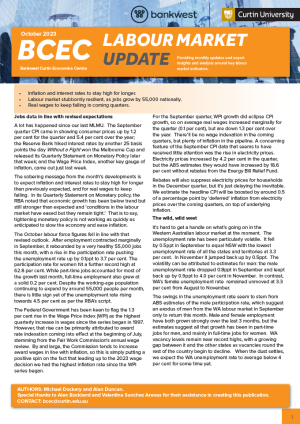 – Inflation and interest rates to stay high for longer – – Labour market stubbornly resilient, as jobs grow by 55,000 nationally – – Real wages to keep falling in coming quarters – Jobs data in line with revised expectations... Read article
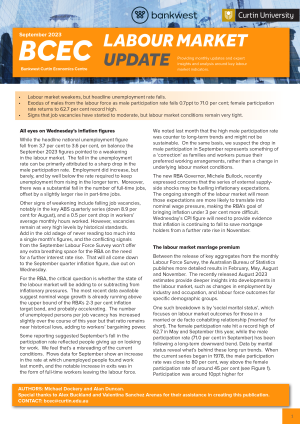 — Labour market weakens, but headline unemployment rate falls. — — Exodus of males from the labour force as male participation rate falls 0.7ppt to 71.0 per cent; female participation rate returns to 62.7 per cent record high. — —... Read article
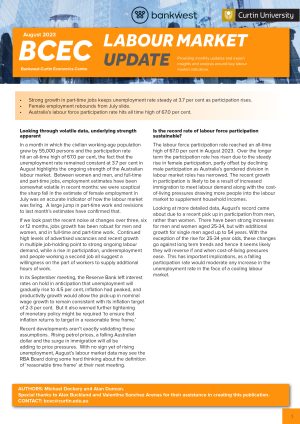 — Strong growth in part-time jobs keeps unemployment rate steady at 3.7 per cent as participation rises. — — Female employment rebounds from July slide. — — Australia’s labour force participation rate hits all time high of 67.0 per cent.... Read article
 The Bankwest Curtin Economics Centre team acknowledges the Wadjuk Nyungar people as the traditional owners of the land on which the Centre is situated.