


WA’s $10 billion question: are we capturing enough value from our resources?

- Resources contribute almost $200 billion to WA economy each year
- Transition minerals could be worth more than $100 billion annually by 2050
- State’s next mining boom must be about value, not volume
- Fiscal policy choices could shift billions of dollars in future public revenues
Western Australia risks missing the next wave of global resource investment unless it moves beyond its traditional “dig and ship” model, a major new report has found.
New analysis from the Bankwest Curtin Economics Centre latest report, WA’s Resources Sector in Transition: Securing long term value in a changing world, finds the resources sector still underpins the State’s economy, contributing $200 billion each year and driving jobs, exports and government revenue.
But the report warns the conditions that have delivered decades of prosperity are rapidly shifting, with decarbonisation, technological change and intensifying global competition reshaping resource markets and that the next phase of growth will be driven by value not volume.
Report co-author and BCEC Director Professor Alan Duncan said Western Australia was entering a pivotal period and without a deliberate shift towards higher-value industries, processing and innovation, it risks being outpaced.
“For decades, our prosperity has been built on extracting and exporting resources,” Professor Duncan said. “That model has served Western Australia incredibly well, but the next chapter will look different. The big question is not whether we have the resources. It’s whether we can create more jobs, more industries and more long-term value from them before they leave our shores.”
The report found iron ore remains a cornerstone of WA’s economy, generating around $126 billion in economic output and accounting for more than 80 per cent of WA’s royalty revenue – but will account for a declining share in output over time.
At the same time, demand for critical minerals needed for batteries, electric vehicles, renewable energy and emerging technologies is expected to grow strongly over coming decades.
Report co-author Dr Silvia Salazar said WA had a rare opportunity to build on its existing strengths, if it acts now.
Under future scenarios modelled in the report, critical minerals, processing and other value-added industries could generate more than $100 billion a year by 2050 – a fivefold increase from around $20 billion today, she said.
At the same time, fossil fuel exports decline from around $39 billion in 2025 to approximately $11 billion by 2050 under the accelerated scenario.
“We have the minerals, the expertise and the global reputation to be a leader in the industries emerging from the global energy transition,” Dr Salazar said. “But success isn’t guaranteed. Other countries are competing hard for the same opportunities, and if we want to capture a larger share of global demand we will need the right energy, infrastructure, skills and investment settings in place.”
Mining and petroleum royalties delivered almost $10 billion to the WA Government last year, around one-fifth of total State revenue.
Professor Duncan said that level of reliance highlights the need for coordinated action across government, industry and the community to capture the full benefits of the transition and secure long-term prosperity for future generations.
“WA earned almost $10 billion last year from finite resources and that prompts an important question: what are we leaving behind for future generations?” he said. “Resource wealth has helped build our hospitals, schools, roads and public services. But these resources won’t last forever.”
The report also examines a range of alternative fiscal settings, including royalty reform, changes to resource taxation arrangements and a hypothetical public equity stake in a major LNG development.
The modelling finds that relatively modest changes to fiscal settings can generate billions of dollars in additional public revenues.
For example, the approval of the Browse LNG project could generate tens of billions of dollars in additional state and Commonwealth revenues between now and 2050, while alternative royalty structures can materially alter the timing and distribution of those returns.
The report also finds that a hypothetical 30 per cent public equity stake in a new $50 billion LNG project could create a long-term revenue stream extending well beyond the productive life of the resource if returns were invested through a future fund model.
“One of the key lessons from the report is that policy settings matter,” Professor Duncan said. “The difference between one fiscal arrangement and another can amount to billions of dollars over the life of a project. The challenge is making sure today’s mining wealth becomes tomorrow’s industries, jobs and fiscal value. Every tonne we extract should help build a stronger future for Western Australia.”
The report outlines a series of policy priorities to support a successful transition, including moving further up the value chain, investing in enabling infrastructure, strengthening innovation and productivity and building globally competitive industries linked to the energy transition.
Key Recommendations
- Capture more value in WA – expand processing and downstream industries to lift jobs and long-term returns.
- Invest in enabling infrastructure – strengthen energy, transport and industrial systems to unlock new industries.
- Compete for global investment – position WA as a leading destination for capital in critical minerals and low-emissions industries.
- Lift skills, productivity and innovation – build workforce capability and accelerate technology adoption.
- Plan for changing revenue streams – prepare for shifts in royalties and taxes as the commodity mix evolves.
- Turn resource wealth into lasting public value – convert finite resources into enduring economic and social outcomes for future generations.
Media Enquiries
Joanna Holcombe, Research and Industry Engagement Manager, Bankwest Curtin Economics Centre
Tel: (08) 9266 2873
Mobile: 0414 313 521
Email: joanna.holcombe@curtin.edu.au
Web: https://bcec.edu.au/media/
Laura Thomas, Corporate Communications Consultant, Curtin University
Tel: (08) 9266 4243
Mobile: 0466 561 374
Email: laura.thomas@curtin.edu.au
Further Information
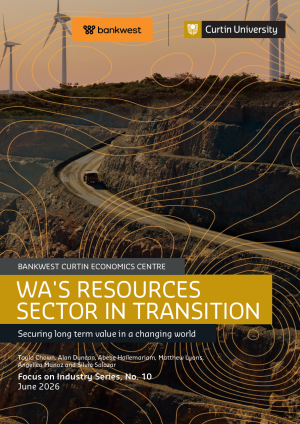 Western Australia’s Resources Sector in Transition: Securing long term value in a changing world
Executive Summary Western Australia’s prosperity has been shaped by one of the most remarkable resource endowments in the world. Over the past several decades, the state’s resources sector has transformed it into a global economic powerhouse. Resources now contribute around... Read article
 Executive Summary: Western Australia’s Resources Sector in Transition: Securing long term value in a changing world
Executive Summary Western Australia’s prosperity has been shaped by one of the most remarkable resource endowments in the world. Over the past several decades, the state’s resources sector has transformed it into a global economic powerhouse. Resources now contribute around... Read article
Presentation: WA’s Resources Sector in Transition: Securing long term value in a changing world
View the slides by lead Bankwest Curtin Economic Centre authors Professor Alan Duncan and Dr Silvia Salazar from the launch of the report WA’s Resources Sector in Transition: Securing long term value in a changing world. About the report The... Read article
 The Bankwest Curtin Economics Centre team acknowledges the Wadjuk Nyungar people as the traditional owners of the land on which the Centre is situated.
